
The test was already half filled in when they handed it to you.
Open the first module of almost any life audit, including the one in my own curriculum, and the instruction is the same. Draw a circle. Divide it into four equal sections. Label them Health, Relationships, Career and Purpose, Personal Growth. Write one to three words in each.
Read that instruction again and count what it has already decided.
That your life has four areas. That they are the same size. That they sit at the same distance from you. That none of them overlap, and none of them are missing.
You did not answer any of that. It arrived answered.
The only variable the template left you is the words. And words are the one output you can fully manage. You have had decades of practice choosing how to describe yourself. You will write busy instead of consumed. You will write fine. Not because you are lying, but because by the time a description reaches the page it has passed through the part of you whose whole job is to make it sound reasonable.
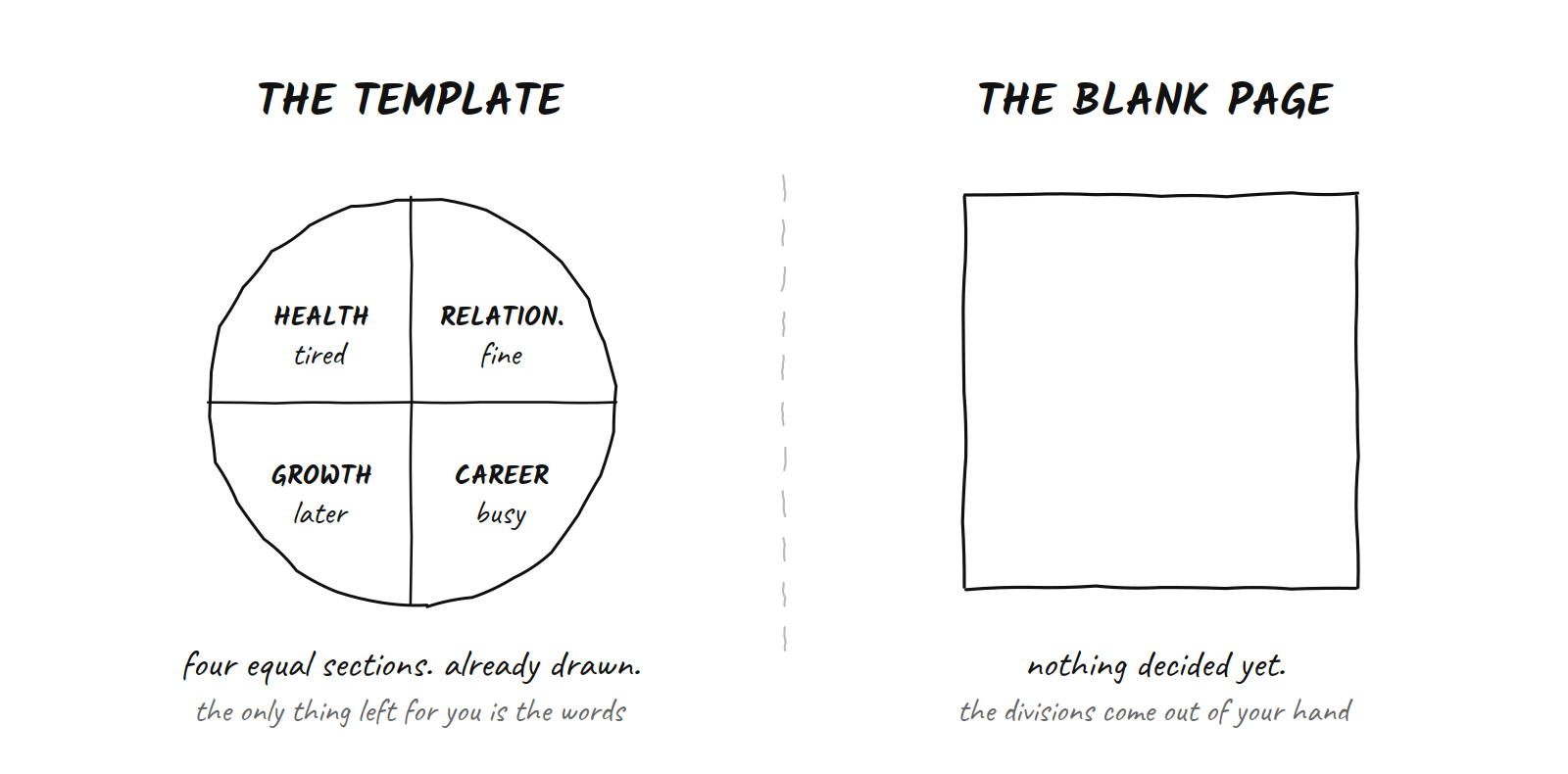
Call it the pre-drawn circle. An instrument that arrives already divided cannot measure the division. It can only measure how you feel about a shape somebody else chose.
This is not a small technicality. Every serious measurement in the world gets blinded, and not because subjects lie. It is because a person who can see what is being scored will move toward the score without ever deciding to. You have never taken a self-assessment that was blinded. You could read every question. You knew what a good answer looked like before your pen moved.
I learned young that the format of a test decides what it is able to find. Somewhere between five and seven, in a classroom in Montreal, a teacher pressed her finger into the top of my head and said don't be stupid like a drumbeat. Every instrument in that room agreed with her. Two decades later, in the art world, the same brain read a room faster than anyone standing in it and that was called an asset. Nothing about me had changed in between. The instrument had.
So the fix is not more honesty. You are already honest. The fix is a format you cannot pre-read.
The Exercise: The Blank Page Map
Step one. Four minutes.
Do not read step two first. Cover it if you have to. The whole thing depends on you not knowing what will be read.
Take a blank sheet of paper and a pen. No circle. No sections. No ruler.
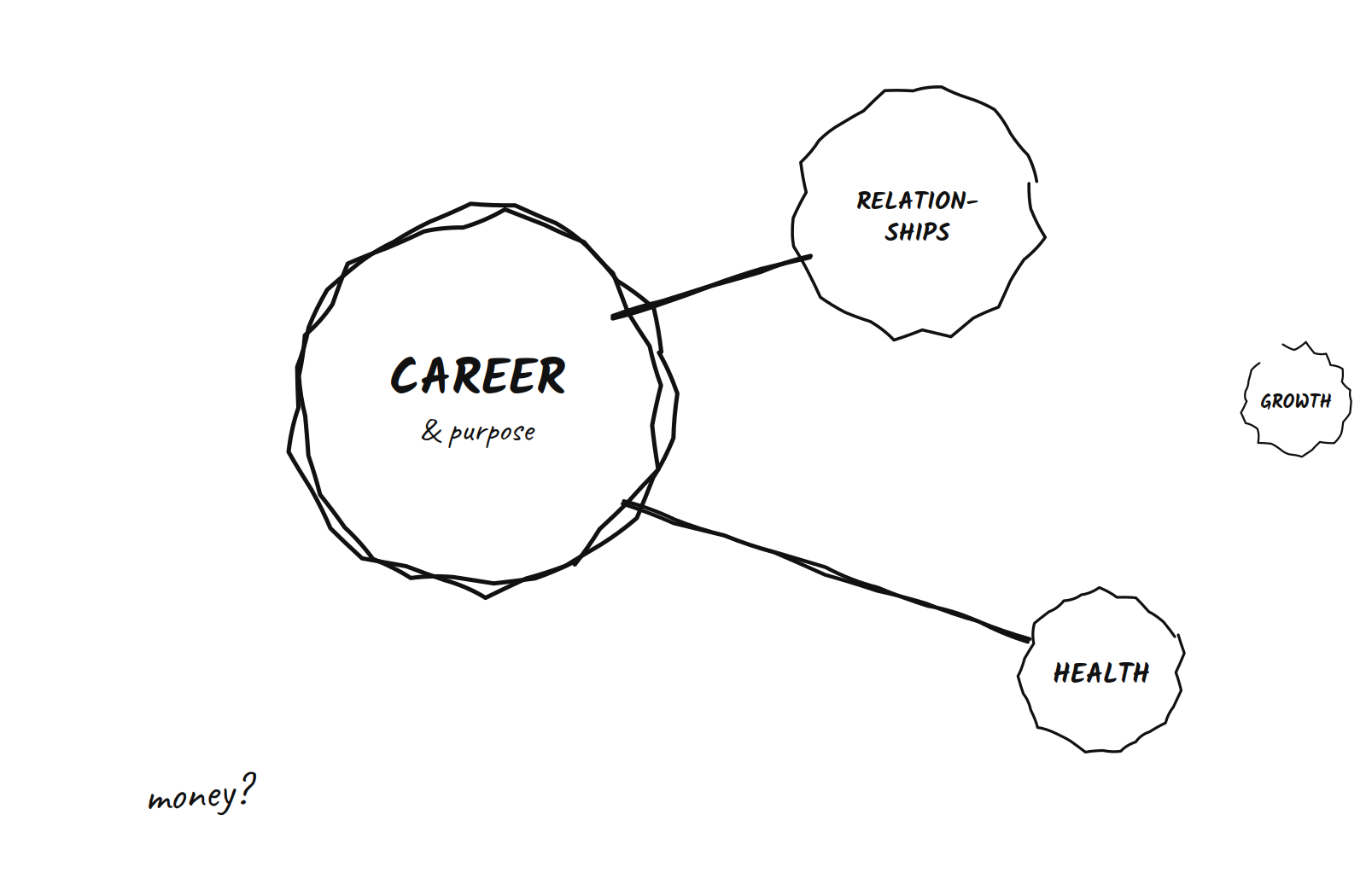
Draw the four areas of your life as shapes on the page: Health, Relationships, Career and Purpose, Personal Growth.
Size them however your hand sizes them. Put them wherever they land. Draw a line between two areas only if the line feels true. If something shows up that was not on the list, put it on the page anyway.
Do not plan the layout. Do not restart. Four minutes, then pen down.
Step two. The reading pass.
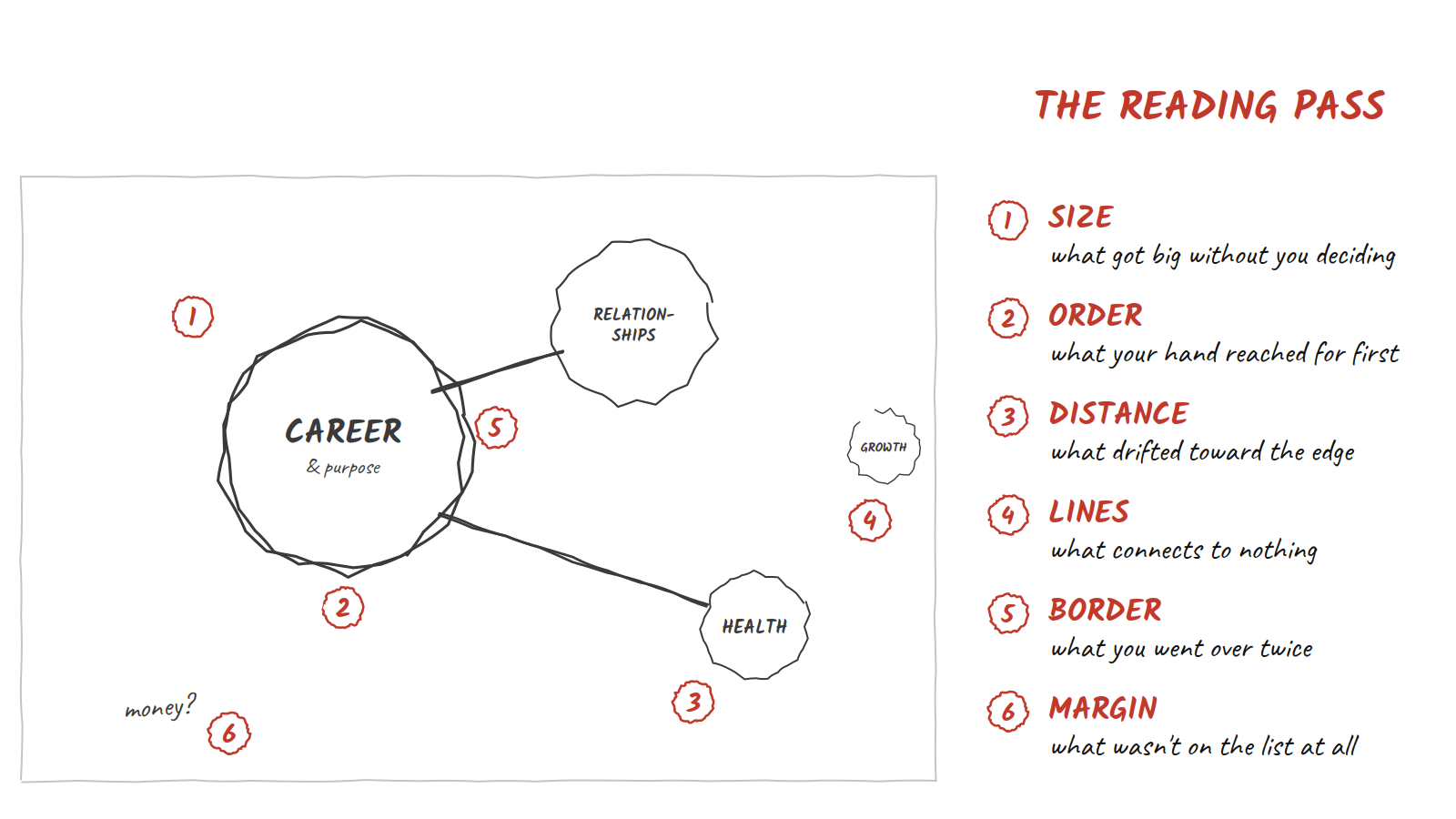
Now read what your hand already answered while you thought you were just drawing.
1. Size. Which shape is biggest? You never chose a scale. Your hand chose one. Size is not importance. Size is occupancy, how much of you an area is currently taking up.
2. Order. Which did you draw first? First is rarely the most valued. It is usually the most loaded, the one running closest to the surface.
3. Distance. What sits near the middle of the page, and what drifted toward the edge? Distance from center is distance from your daily attention, and it is measured in your own hand, not your own opinion.
4. Lines. What connects to what, and what connects to nothing? An area with no lines is an area running with no support from the rest of your life. It is not independent. It is unsupplied.
5. Border. Did anything get a heavy outline, a second pass, a box? You do not go over a line twice by accident. Enclosure is defense, and defense means something in there is being protected from the rest.
6. Margin. What did you write that was never on the list? Money. A person. A city. That item is doing structural work in your life while holding no official position in it, which is exactly why it never gets managed.
Step three. One sentence.
Write the single thing on this page you would not have written if you had started with the template.
Not a plan. Not a resolution. One sentence describing what the page shows that the four equal quadrants would have flattened.
Date it. Fold it into the back of the notebook. If you took the Eight-Week Marker last week, put this page in the same envelope.
You cannot fix any of this today, and that is not what the page is for. The page is a record made before you knew what was being scored, which makes it the only reading you have that you did not have a chance to improve.
The circle you were handed was not neutral. Nothing that arrives already divided ever is.
And once you have seen that clearly, you will start noticing the others. The job title with three responsibilities listed. The calendar split into equal hours. The four categories your week gets sorted into every Monday morning. Every one of them arrived with the sections already drawn, and every one of them is quietly measuring how you feel about a shape you never chose.
Start with the paper. The rest becomes visible from there.



Responses